Caution: Your Brain Has Already Checked Out — The Glorious Stupidity of Ignoring Wet Floor Signs
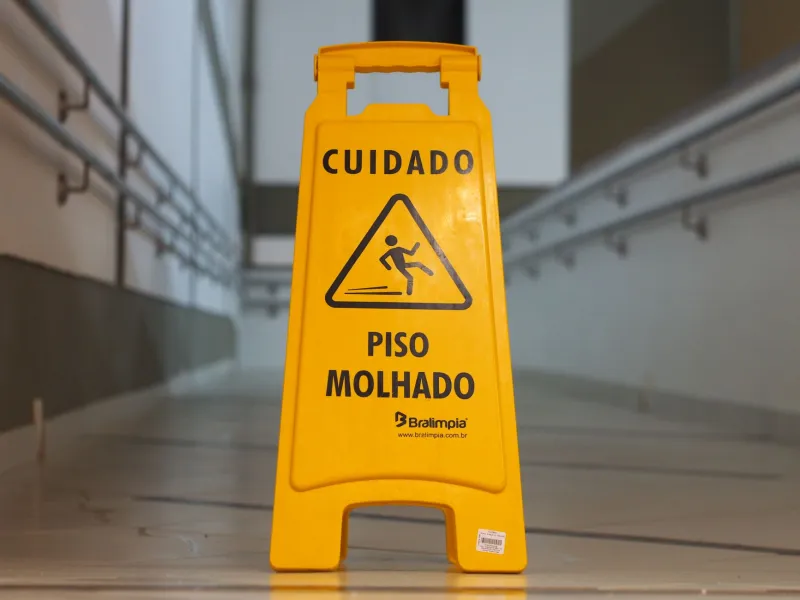
Let's set the scene. You're walking through a Costco, Target, or some other fluorescent cathedral of American commerce. You're minding your business. You're possibly thinking about whether you left the stove on. And then — there it is. The little yellow plastic cone. The internationally recognized symbol for please, for the love of everything, watch your step.
Your eyes register it. Your brain files it. And then your feet, operating on some deeply cursed autopilot, carry you directly into the wet zone like you're auditioning for a slapstick film nobody greenlit.
Welcome to the Wet Floor Sign Paradox. Population: all of us, at some point, on our backs.
Your Brain Is Basically a Toddler Who Was Told Not to Touch the Stove
Here's the thing that should make you feel simultaneously better and much, much worse: this isn't entirely your fault. Psychologists have a term called reactance, which is essentially your brain's internal toddler throwing a fit whenever it perceives a threat to its freedom. Tell someone not to do something, and a small but very loud part of their nervous system immediately wants to do exactly that.
The wet floor sign, in this framework, isn't a warning. It's a dare.
But reactance is only half the story. There's also the phenomenon researchers call risk compensation — the well-documented human tendency to behave more recklessly when we feel like safety measures are already in place. It's why people drive faster in cars with more airbags. It's why you text at a crosswalk because, hey, the light is red. And it's why your brain, upon spotting the wet floor sign, quietly whispers: someone already handled this. You're fine. Walk normally.
Spoiler: you are not fine. Walk slower.
The Evolutionary Case for Being an Idiot
If you want to feel even more absolved, consider this: humans are wired for novelty and drawn toward uncertainty in ways that served us pretty well on the savanna and serve us extremely poorly on freshly mopped linoleum.
Our ancestors who cautiously avoided every ambiguous situation didn't exactly thrive. The ones who poked the weird thing, crossed the sketchy bridge, and investigated the suspicious rustling? They found food, mates, and territory. Natural selection, in its infinite wisdom, built us to lean in to the unknown. The wet floor sign represents the unknown. Your prehistoric brain sees opportunity.
Your modern tailbone disagrees.
There's also the attention economy problem. We are, collectively, drowning in warnings. Warning labels on coffee cups. Caution tape at construction sites. Pop-up alerts on our phones. Surgeon general notices on literally everything enjoyable. At some point — and scientists call this warning fatigue — our brains start filtering out cautionary signals the way we filter out banner ads. The wet floor sign becomes visual background noise. A prop. Set dressing.
Until it isn't.
A Completely Unofficial Tier List of Humiliating Slip Locations, Ranked by Witness Count
Not all falls are created equal. The dignity lost in a slip-and-fall event scales almost perfectly with the number of people who saw it happen. Herewith, a definitive ranking:
S-Tier: Maximum Humiliation
- The airport terminal — hundreds of strangers, all bored, all looking for entertainment, all now watching you
- The wedding reception dance floor — it's already slippery, someone definitely filmed it, and it will be in the slideshow
- Costco on a Saturday — the square footage alone guarantees a crowd radius of forty feet minimum
A-Tier: Deeply Uncomfortable
- Any restaurant, specifically while carrying food — the fall AND the crash AND the plate AND the gasp from the entire dining room
- Your workplace lobby — you will see these people every day for years
- A first date location — statistically, this ends the relationship AND begins a story they tell forever
B-Tier: Survivable, Barely
- The grocery store — witnesses exist but are generally sympathetic; they've been there
- A gym — everyone is too focused on themselves to fully process your suffering
- A hotel hallway — one or two witnesses, low stakes, you'll never see them again
C-Tier: Almost a Private Moment
- Your own kitchen — no witnesses, but you have to tell someone because it was incredible
- The backyard — dignity preserved; the dog saw nothing
F-Tier: Somehow Worse Than Everything Else
- Any situation where you confidently told someone nearby to be careful — directly followed by your own catastrophic slip. This is karmic comedy at its most ruthless, and approximately 100% of people who have experienced it have gone on to question the entire concept of a just universe.
Real Disasters, Real People, Real Regrets
The internet, bless its chaotic heart, is a graveyard of wet floor sign humiliations. There's the classic Reddit thread where a man described sliding six feet across a freshly waxed hospital corridor while holding a coffee and a get-well balloon — the balloon surviving completely unscathed, floating serenely above his crumpled form like a tiny Mylar angel. There's the woman who slipped in a grocery store, caught herself on a display of canned soup, sent approximately forty cans cascading to the floor, and then — in the confusion of the crash — slipped again on the cans. A two-slip incident. The rarest and most devastating classification.
And then there's the eternal humiliation of the slow-motion fall. You know the one. Where you see it coming, you know it's happening, and the two seconds between oh no and oh no it happened stretch into a horrible eternity where you have just enough time to make eye contact with a stranger before gravity takes the wheel.
The Part Where We Learn Nothing
Here's where we'd normally wrap up with some useful takeaway. A life hack. A behavioral tip. Slow down near wet floor signs. Look before you step. Engage your core.
But honestly? You already know all of that. You knew it before the last time. You'll know it before the next time. And the next time will still happen, because you are a human being, and human beings are a species that built cities and split atoms and also absolutely cannot be trusted around a freshly mopped Walgreens floor.
The wet floor sign will be there. Yellow and cheerful and completely ignored.
And somewhere, somehow, your feet will make a choice.
May your fall be graceful, your witnesses few, and your ego resilient enough to laugh about it later. That's really all any of us can hope for.
Life's messy. We slip anyway.