Stand Right, Walk Left, and Pray Nobody Notices You Blew It: The Unspoken Escalator Code We're All Failing
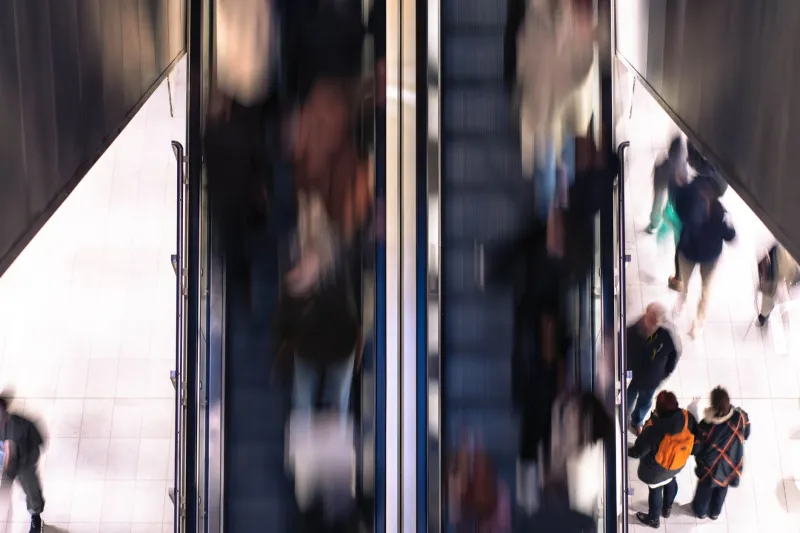
Somewhere between the food court and the Macy's entrance, you committed a crime. You didn't mean to. You never do. But you stood on the wrong side of the escalator, and fifteen strangers watched it happen in complete, seething silence. No one said a word. No one ever does. That's the whole terrifying thing.
Welcome to escalator etiquette — the social contract nobody signed, nobody taught you, and everybody enforces with the quiet fury of a disappointed parent at a school play.
The Rules (Which Are Definitely Real, Except When They Aren't)
Here's what most people believe: you stand on the right, you walk on the left. Simple. Clean. Civilized. This is the gospel in cities like Washington D.C., where the Metro escalators are long enough to make you rethink your life choices, and where violating the walk-left rule can earn you a very direct, very un-Midwestern correction from a stranger in business casual.
Except — and this is where it gets fun — that's not the rule everywhere.
In some cities, the convention is flipped. In others, there's no convention at all, just a chaotic free-for-all that looks like the first five seconds of a Black Friday sale. New York City, in a move that surprises absolutely no one, has largely abandoned the stand-right rule in favor of everyone just kind of doing whatever they want while looking mildly furious about it. The Metropolitan Transportation Authority actually ran a campaign a few years back encouraging people to just stand on both sides because the constant one-side traffic was wearing out the escalator steps unevenly. The city's response to that campaign was essentially: no.
And in malls across suburban America? Total anarchy. You've got stroller-pushing parents blocking the full width, teenagers standing four across like they're posing for an album cover, and at least one guy in cargo shorts who seems genuinely confused that the stairs are moving.
The Silent Judgment Is Very, Very Loud
Here's what nobody talks about: the emotional experience of being stuck behind someone who doesn't know the rules — or worse, knows them and simply doesn't care — is genuinely unhinged in its intensity.
You're not going to say anything. Of course you're not. This is America; we will suffer in polite silence until we can complain about it to someone else later. But inside? Inside, you are composing a strongly worded internal monologue. You are sighing in a frequency only dogs can hear. You are doing a full psychological assessment of this person based entirely on their escalator positioning.
They're probably the kind of person who takes forever in the self-checkout line too.
They definitely recline their seat on a two-hour flight.
They are, without question, a monster.
None of this is rational. All of it is happening.
Regional Chaos: A Brief Tour of Escalator America
D.C. residents will tell you, with the particular confidence of people who live near the seat of federal power, that stand-right-walk-left is simply correct and everyone else is wrong. Chicago has a similar energy, though with slightly more passive aggression baked in. Chicagoans will not confront you, but they will absolutely discuss you.
In Los Angeles, escalator etiquette is complicated by the fact that half the population hasn't been on public transit in six years and approaches the moving stairs with the cautious wonder of someone encountering a escalator for the first time in a nature documentary. The other half is in a hurry to get nowhere in particular but needs you to know it.
Boston operates on its own system entirely, one that appears to be based on historical grudges and the layout of streets that were originally cow paths. Nobody fully understands it. Just keep moving and don't make eye contact.
And then there's the American mall. God bless the American mall. The escalator inside a suburban shopping center is where all rules go to die peacefully, surrounded by the smell of Auntie Anne's pretzels and the sound of a mid-tempo pop song from four years ago. Families spread out. Couples hold hands across both lanes. A child sits directly on the step and nobody stops them. It is chaos. It is freedom. It is somehow both deeply frustrating and kind of beautiful.
Why We Can't Just... Say Something
The real question — the one that gets at something genuinely weird about how we function as a society — is why nobody says anything. Ever.
We will tweet about escalator blockers. We will vent to our friends over drinks. We will post to Reddit threads that get four thousand upvotes from people who absolutely know what we're talking about. But in the actual moment, standing six inches behind someone who is casually ruining our commute? Silence. Total, absolute silence.
Part of it is conflict avoidance, obviously. We are a culture that will go to extraordinary lengths not to have a direct, mildly uncomfortable conversation with a stranger. We will miss our train. We will be late to work. We will silently seethe for forty-five seconds on a moving staircase rather than say "excuse me" like an adult.
But part of it is also the uncomfortable truth that the rules aren't written down anywhere. There's no escalator etiquette laminated sign (and in the rare cases there is, people ignore it anyway). So saying something feels presumptuous — like you're enforcing a law you're not entirely sure exists. What if they look at you blankly and say "there's no rule"? What if they're right? What if you're the problem?
This is the existential spiral the escalator delivers to you, free of charge, on your way to buy a pair of shoes you don't need.
The Bottom Line, Which Is Also the Moving Bottom Step
Escalators were invented to make life easier. To take the effort out of going from one floor to another. They are, in theory, a gift — a small mechanical kindness in an exhausting world.
Instead, we have turned them into a microcosm of every social anxiety we carry: the fear of judgment, the inability to communicate directly, the desperate need to follow invisible rules while simultaneously not knowing what those rules are or whether they apply here.
We're all doing it wrong. Nobody will tell us. We will continue.
Now please, for the love of everything, scoot to the right.