Gravity Always Wins, and It Always Has an Audience: The Cruel Science of Spectacular Falls

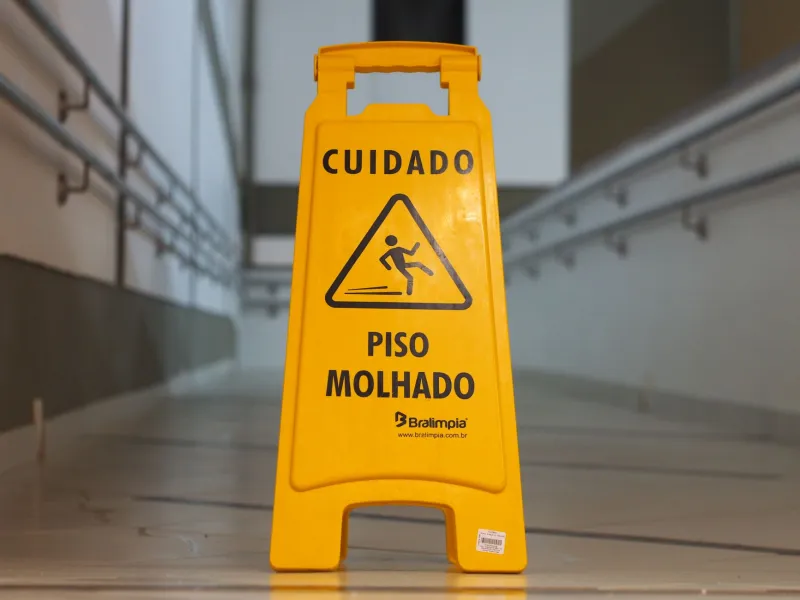
Let's set the scene. You're in the break room at work. It's a Tuesday. The floor was mopped sometime in the last hour, though no one thought to leave a sign — because of course they didn't. You're carrying a ceramic mug that says "But First, Coffee" and you are feeling, against all available evidence, like a functional adult. Then your right foot finds that one invisible slick patch, your left leg shoots out at a forty-five-degree angle, the coffee achieves liftoff, and you perform what can only be described as an interpretive dance about the fragility of human dignity.
Three coworkers witness this. One of them laughs so hard she has to leave the room. You stand up, nod gravely, and say "I meant to do that." Nobody believes you.
Welcome to the great rug slip — the defining humiliation of the human experience.
The Physics Are Actively Conspiring Against You
Here's the thing about slippery surfaces: they don't care about you. That area rug with the cute geometric pattern that looked so good on the Wayfair listing? It's been plotting since the day you unrolled it. The coefficient of friction between a shag rug and hardwood floors is somewhere between "please don't" and "absolutely not," and the moment you're wearing socks — especially those silky athletic socks that feel like tiny ice skates — you've already lost.
Physicists will tell you that a slip occurs when the horizontal force you're applying to a surface exceeds the maximum static friction that surface can provide. What physicists will not tell you, but what every person who has ever wiped out at a bowling alley rental desk knows intuitively, is that this calculation somehow always resolves itself at the worst possible moment.
Wet tile after a shower? Fine. Same wet tile the morning your in-laws arrive and you're trying to look like someone who has their life together? Absolute carnage.
The Audience Effect: Why Embarrassment Has a Multiplier
Psychologists have a concept called "social facilitation," which is the idea that people perform differently — sometimes better, sometimes catastrophically worse — when they're being observed. For complex or unfamiliar tasks, an audience tends to make performance worse. Walking, of course, is not a complex task. You've been doing it for decades. But the moment you become aware that someone is watching, your brain helpfully begins narrating the process in real time.
Okay, left foot, now right foot, shift the weight — wait, is the floor wet? It looks a little wet. Should I slow down? I'm slowing down. Why am I thinking about walking? I've never thought about walking before. Oh no.
And that's when you go down.
The embarrassment amplification that follows is its own separate catastrophe. Studies on social pain show that embarrassment activates some of the same neural pathways as physical pain, which is why a spectacular public wipeout can genuinely haunt you for years. You don't just feel the fall — you feel every set of eyes that tracked your descent, every suppressed laugh, every "oh my gosh, are you okay?" delivered with a smile that says I am going to tell everyone about this.
A Brief, Completely True Taxonomy of Witness Scenarios
Not all audiences are created equal. The damage to your psyche scales dramatically depending on who saw you eat it.
The Stranger You'll Never See Again: Theoretically the best-case scenario. In practice, you will still think about this person at 2 AM for the next decade.
The Coworker: Dangerous. This person will say nothing for three weeks and then bring it up at your retirement party.
The Crush: Statistically, the universe saves its best material for this exact situation. If you have ever fallen in front of someone you were trying to impress, you know that no amount of "playing it cool" undoes a full horizontal slam into a linoleum floor.
A Small Child: Children are brutally honest and have no mercy. They will point. They will laugh. They will reenact your fall for their parents at dinner.
Your Dog: Technically not a witness in the human sense, but the way they look at you — head tilted, utterly baffled — somehow makes it worse.
Are Some People Actually Clumsier, or Just More Honest?
This is the question that divides households. Every friend group has that one person who seems to be in a constant state of low-grade physical disaster — knocking things off shelves, tripping over flat surfaces, performing the full "Bambi on ice" routine at the first sign of a wet floor. And then there are people who claim they never fall, never slip, never so much as stub a toe.
Here's the truth: those people are lying.
Research on clumsiness suggests that some individuals do have genuine differences in proprioception — the body's ability to sense its own position in space — which can make coordination more challenging. Fatigue, distraction, and anxiety all measurably increase the likelihood of a slip or fall. But the gap between "clumsy person" and "graceful person" is far smaller than the graceful person wants you to believe. What actually separates them is audience size and willingness to disclose.
The person who claims they never fall simply falls in private and tells no one. The person who falls constantly does so in the middle of a crowded Target and cannot stop talking about it. Neither is more or less coordinated. One of them is just funnier at parties.
The Rug Pull as Life Metaphor (Bear With Us)
There's something almost poetic about the way a slippery surface catches you off guard. You're moving through life with confidence — maybe even a little too much confidence — and then the floor decides it's done participating in your narrative. You didn't see it coming. You couldn't have prepared for it. And the very moment you were most visible, most observed, most trying to hold it together, the universe reached out and yanked the rug from under you.
Which is, honestly, just Tuesday.
The good news — and there is good news — is that falling in front of people and surviving is one of the most reliable ways to become a person worth knowing. Nobody wants to hear about the time you walked gracefully across a room. They want to hear about the coffee mug. They want the full reenactment, complete with sound effects. The falls are the stories. The slips are the content.
So yes, gravity always wins. Yes, there will always be witnesses. Yes, the rug will always be slightly more slippery than it has any right to be.
Get up. Nod gravely. Tell them you meant to do that.
Nobody will believe you, and that's perfectly fine.